

TRADING DESKS
Read the venue, the rules and the cost at size
See one event on Kalshi, Polymarket International and Polymarket US side by side. Price a size you type on each venue's book after fees, read where the rulebooks differ, and check how related contracts depend on each other.
Trading desk research workflow
For trading, market-making and research desks: what does a defined size cost on each venue's book after fees, do the rules of the contracts match, and how do related contracts depend on each other?
- In Trading desks, open Monitor to see one event across the venues, with each ladder as the venue words it.
- Open Liquidity and cost and type a size in US dollars. The demo walks each book level by level, adds each venue's published fees and shows how much of the size the visible book can fill. Nothing is worked out until you type a size.
- Open Rules and basis to see where the rulebooks differ, and Read for position to see what a position pays in each state. Dependence shows how two contracts relate under their rules; Event response and Distributions set the market beside public records.
Research output
A price at a size you typed, after fees, beside the rules that decide what the position pays. It is not an order or a reserved quote.
Limitations to carry forward
Observed depth can change before a later order. Fees are modelled from each venue's published schedule; queue priority, hidden liquidity and latency are not modelled, and nothing here can guarantee execution. Open records read live books for display only; settled records keep their recorded prices. Live prices are not stored and are not offered as files. Cross-source analysis requires two currently entitled sources, a current human-reviewed mapping and eligible observations.
In the demo
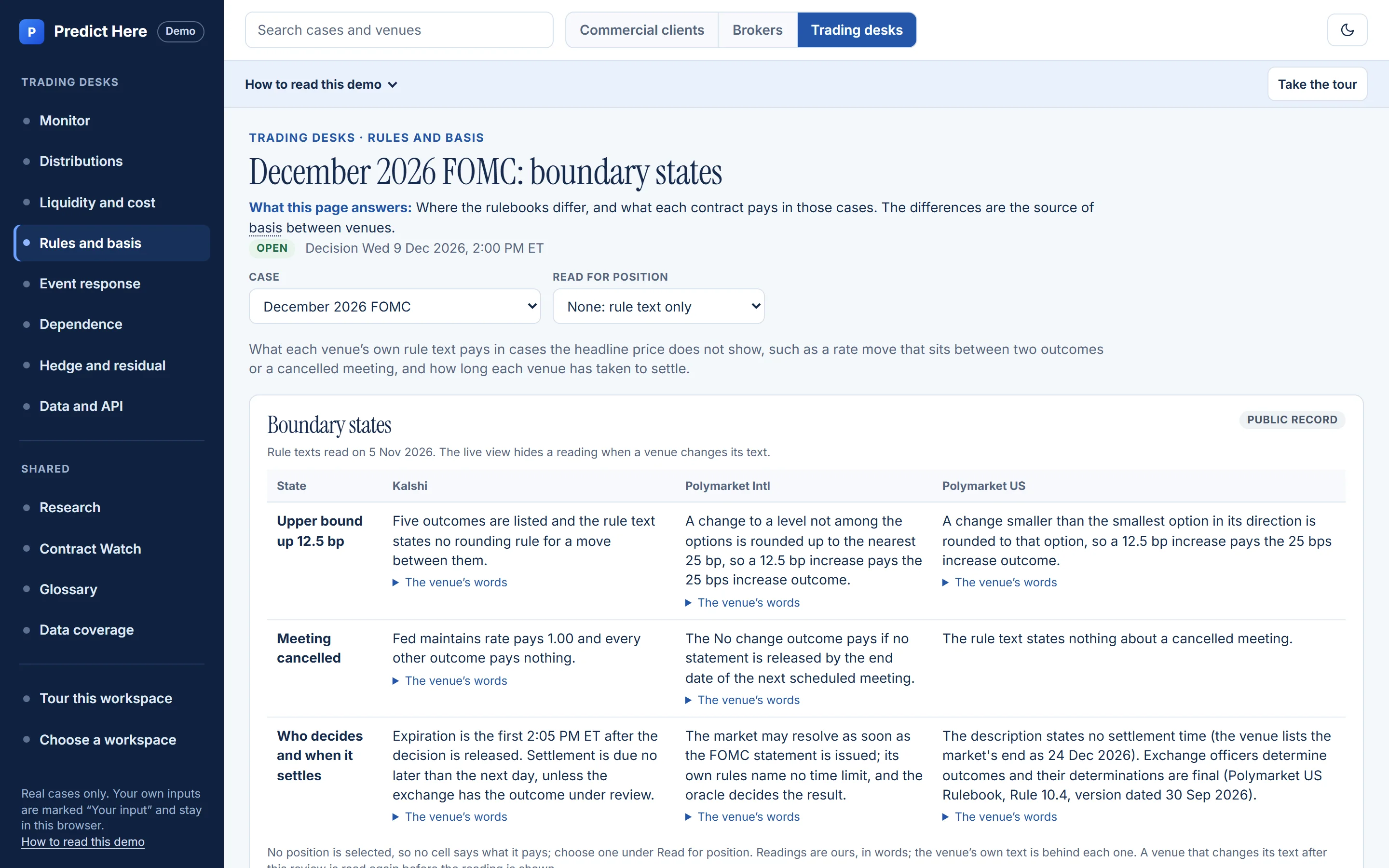
The trading desk's Rules and basis view: where the three venues' rulebooks differ, in plain words, with each venue's own text a click away.
What you get
Top-of-book describes one displayed level. A size-specific calculation walks the book level by level; it cannot guarantee what a later order would execute. Figures carry their source, time and method.
Capability status describes what is implemented. Venue rows: Live means Predict Here read that venue's public market data and got an answer within the last five minutes. Otherwise the venue shows the stored-price collector's last run, refreshed every 5 minutes. They do not establish that data reaches your organization. Delivery and organization source rights are separate checks; a plan alone does not grant source access.
| Capability | Status | Explore | Delivery |
|---|---|---|---|
| Price at size at every ladder notional, from $10,000 to $1,000,000 | Available | Limited | Event workstation |
| Slippage against the reference mid, in probability points | Available | Limited | Event workstation |
| Capacity bands at ±1 · ±2 · ±5 probability points | Available | Limited | Event workstation |
| Named relationships between contracts on one canonical event, each with a verification state | Available | Limited | Event workstation |
| Provenance and version ids on every published figure | Available | Limited | Event workstation |
| Liquidity-shock, probability-move and rules-changed signals on your watchlist | Available | Evaluation required | Alerts |
| The same records programmatically, for a research pipeline | Available | Evaluation required | Production API |
| Developer Sandbox keys, self-serve from your account settings | Available | Included | Developer Sandbox |
| Positions and collateral mapped into the canonical event graph | Private beta | Evaluation required | Risk workspace |
| Terminal-state exposure, liquidity stress and PH Shadow Initial Margin (analytical, not venue margin) | Private beta | Evaluation required | Risk workspace |
| Bulk history for backtesting | Planned | — | Bulk institutional historical exports |
| Cross-source comparison only when rights and a reviewed mapping permit it | Built; availability conditional | — | Not delivered today |
Data and API
Review available market records with their source identity, observation times, native units and quality context. Discuss the coverage and delivery required for your research workflow.
Datasets download as JSON or CSV for public, settled and archived data. Live venue prices are display only and are not offered as files. A download does not grant credentials or broader redistribution rights. Canonical routes require a signed-in organization session; production API-key transport is unavailable for them. Bulk point-in-time history remains planned. Source rollout, current rights and organization access remain separate from code support.
Portfolio & risk
A separate workspace on the same event graph: review recorded positions, their exposure and stress outcomes. Analytics only; Predict Here holds no collateral, sets no margin requirement and executes nothing. This workspace remains in the published private-beta profile. Collateral depends on account snapshot inputs; missing contributing values leave the total blank. Access is through an Institutional Evaluation or Institutional plan, not Explore.
- Positions and collateral
- Position snapshots can be mapped into the canonical event graph and marked against published figures. Collateral depends on recorded account inputs; if any contributing account value is missing, the total stays blank instead of being partially summed.
- Event-state exposure
- Contractual loss across every terminal state of a canonical event, so deterministic offsets between related contracts net out instead of being counted twice.
- Stress and liquidity
- Probability shocks on a fixed grid, and a liquidity-stress figure walked from the same visible order-book depth the execution ladder uses. Where depth cannot support the position, the shortfall is stated rather than extrapolated.
- Shadow initial margin
- An indicative capital-at-risk estimate under the scenarios above, including concentration and near-resolution add-ons. It is Predict Here’s own model output — not a margin requirement, and not recognized by any venue, broker or clearing house. The near-resolution parameter is not yet calibrated, and every affected run is stamped with that warning.
Every run records the model version and a hash of the exact parameters behind it, so a figure can be reproduced under the rules that produced it. A run whose inputs are too stale to trust is recorded as such, with its capital figures left blank rather than estimated. This is analytics, not a clearing service: Predict Here sets no margin requirement, issues no margin call, holds no collateral and executes nothing.
Explore the public Demo
Open the trading desk's market views. Live books are read when the page asks, for display only.
- Monitor: one event across the venues
- Liquidity and cost: price a size you type, after fees
- Rules and basis: where the rulebooks differ
- Dependence: how two contracts relate under their rules
- Event response: the 2-year Treasury on FOMC days
- Distributions: the number across venues
- Research: the published papers
Open records read live venue books for display only; settled records keep their recorded prices. No view offers an order, a reserved quote or a promised fill. Anything you type stays in this browser.
Open cases read live venue prices for display only. Settled cases keep their recorded prices. Neither is a quote or an offer to trade.
Your evaluation
Agree the scope and any evaluation costs before work begins. Assess the research on your event set before deciding on ongoing access.
Request evaluation
Tell us your role and your event set. We aim to reply within one business day.Scoping call
Thirty minutes on the events you actually cover and what a useful answer looks like.Institutional Evaluation
Assess the agreed research output against your event set, with source permissions and evaluation terms in view, before deciding on ongoing access.
Demo
Try it in the demo
Three workspaces for commercial clients, brokers and trading desks: a hedging review of your own exposure, and real market records from Kalshi, Polymarket International and Polymarket US. No account needed, and your inputs stay in this browser.
Review a trading research workflow
Discuss the event set, source permissions and sizing question an institutional evaluation would need to cover.