

Access
Three ways in
Start with free event research, evaluate Monitor and the API against your workflow, or arrange ongoing access for your team. Plan limits and availability are shown below.
The three access states
One of these describes you today. None of them is a queue for the others: Explore is a permanent state, not a countdown.
Explore
Free · Permanent · Verified email
Create a free workspace with a verified email — no credit card. With current source rights, read up to 15 curated events with semantics and provenance. One watchlist of up to 10 events, one seat, and price-at-size at $10,000. Signup does not grant source rights.
Institutional evaluation
Qualified · Time-boxed · 14 days by default
A scoped trial on an event universe we agree with you. Approval and activation are separate steps, so the window does not start until your team is ready. When it closes, access returns to Explore automatically unless we have agreed terms.
Institutional
Custom commercial agreement
A continuing relationship: an agreed event universe, agreed delivery, and the data-rights position your firm needs — including the option to use your own licensed venue entitlement. Terms are set per organization, and we do not publish a price list.
What changes between them
These are the things a plan tier actually decides. Capability availability is a separate axis and is stated on its own below.
| What it decides | Explore | Evaluation | Institutional |
|---|---|---|---|
| Getting started | Verified email address. No credit card and no payment details. | Requested on the evaluation form, then qualified and approved by us. | Agreed commercially before access opens. |
| Term | Permanent. It does not expire. | 14 days by default, fixed at activation. | Per agreement. |
| Event universe | 15 curated events, classified under taxo_v1. | The event universe scoped with you on the call. | The event universe scoped with you, revisited as it changes. |
| Quotas | One watchlist of up to 10 events. One seat. No alert rules. | Not capped by plan quota. | Not capped by plan quota. |
| Price-at-size depth | Real numbers at $10,000. The other 5 ladder sizes are shown locked. | The full 6-point ladder, $10,000 through $1,000,000. | The full 6-point ladder, $10,000 through $1,000,000. |
| Canonical data routes | Not issued on Explore. | Use an authenticated organization session. Production API-key transport is not implemented; source delivery remains separately gated by current rights and rollout. | Use an authenticated organization session. Production API-key transport is not implemented; source delivery remains separately gated by current rights and rollout. |
| Your own licensed source entitlement | Not applicable. | A discussion point when we scope your access. | A discussion point when we scope your access. |
- Contract semantics and provenance
- Included at every tier. Every mapping carries one of VERIFIED · PARTIAL · NOT_EQUIVALENT · UNREVIEWED, and every figure carries its source, its as-of time and the version identifiers behind it.
- Developer Sandbox API
- Self-serve at every tier. Create a key from your account settings once you are signed in.
What is available at all, at any tier
A plan tier answers what your organization has bought. It does not answer whether a capability exists yet, and it never answers whether a venue's data may be delivered to you — three separate axes, checked separately on every request. The tables show product maturity, plan scope, and source availability. Enabled, licensed sources can feed scheduled canonical Monitor collection under separate source rights; eligible Polymarket US records require reviewed fixed-payout approval. The dedicated US workspace also supports on-demand reads, with independent organization rights and production gates. These source rights are not plan labels; US records also require fixed-payout review, and production rollout remains separately gated.
Product capability
What exists and how finished it is, alongside what each plan includes. None of these rows is a venue question.
Workstation (Monitor)
AvailableLimitedIncludedThe per-event workstation. Limited on Explore means a curated, capped universe and a single ladder rung; the full universe and ladder otherwise.
Authenticated application APIs
AvailableNot includedIncludedCanonical Monitor routes require a signed-in organization session and applicable rights. Developer Sandbox keys access synthetic sandbox routes only. Production API-key transport is not available for these canonical routes.
Developer Sandbox
AvailableIncludedIncludedSynthetic example data on the exact response contract the live API uses. Self-serve at every tier — create a key from your account settings once you are signed in. Nothing it returns reflects any real market.
Portfolio & risk
Private betaNot includedIncludedPositions mapped into the canonical event graph, with exposure, stress and shadow initial margin computed against the same figures the intelligence layer publishes. Reached through the risk workspace rather than primary navigation.
Alerts
AvailableNot includedIncludedRule-based delivery of the eight signal types. Not included on Explore, since a standing alert rule carries real ongoing cost.
Historical exports
Planned——Planned. Not available at any tier.
| Capability | Status | Explore | Evaluation · Institutional | What it means |
|---|---|---|---|---|
| Workstation (Monitor) | Available | Limited | Included | The per-event workstation. Limited on Explore means a curated, capped universe and a single ladder rung; the full universe and ladder otherwise. |
| Authenticated application APIs | Available | Not included | Included | Canonical Monitor routes require a signed-in organization session and applicable rights. Developer Sandbox keys access synthetic sandbox routes only. Production API-key transport is not available for these canonical routes. |
| Developer Sandbox | Available | Included | Included | Synthetic example data on the exact response contract the live API uses. Self-serve at every tier — create a key from your account settings once you are signed in. Nothing it returns reflects any real market. |
| Portfolio & risk | Private beta | Not included | Included | Positions mapped into the canonical event graph, with exposure, stress and shadow initial margin computed against the same figures the intelligence layer publishes. Reached through the risk workspace rather than primary navigation. |
| Alerts | Available | Not included | Included | Rule-based delivery of the eight signal types. Not included on Explore, since a standing alert rule carries real ongoing cost. |
| Historical exports | Planned | — | — | Planned. Not available at any tier. |
Source and venue availability
This table separates implemented support, current production activation and additional organization/source rights. Polymarket US also has a dedicated on-demand read-only workspace. US and Kalshi production collection are enabled under recorded owner-attested permissions; customer access is not granted by implementation or a product plan.
| Source / venue | Implemented support | Production activation | Additional access requirements | What it means |
|---|---|---|---|---|
| Polymarket | Shared retained pipeline implemented | Enabled in current production configuration | Current organization rights are checked independently at delivery. | International Polymarket is collected into canonical Monitor records. Canonical figures sourced from it name the source; delivery to your organization is subject to its entitlement. |
| Polymarket US | Shared pipeline and on-demand workspace implemented | Enabled in current production configuration | Global source license, organization rights and current human-reviewed fixed-payout admission are required for US prices. | Shared retained collection and the dedicated on-demand workspace are implemented. Production collection is enabled under recorded owner-attested permissions. US prices require separate global source rights, organization rights and a current human-reviewed fixed-$1/$0 payout admission. |
| Kalshi | Shared retained pipeline implemented | Enabled in current production configuration | Global source licensing and current organization rights are both required. | Shared catalog, retained history and consensus support are implemented. Production source collection is enabled under recorded owner-attested permissions; separate organization rights remain required for delivery. |
| Cross-venue comparison | Implemented | Disabled in current production configuration | Two distinct entitled sources, current human proposition/outcome review, complete terms and eligible observations are required. | Comparison support is implemented but conditional. It requires two distinct entitled sources, a current human-reviewed equivalent proposition/outcome mapping and fresh valid observations; no product plan or venue status grants these rights. |
The dedicated on-demand workspace and shared retained pipeline are implemented. Production collection is enabled under recorded owner-attested permissions; organization data rights and a current fixed-payout review are separate requirements. Polymarket US documentation
The licensing axis is the third: each venue's data carries its own entitlement, independent of any plan. A capability being available does not by itself authorize delivery of a given source's data.
INSIDE PREDICT HERE DEMO
Follow the Demo workflow
The captures follow Markets, an exact contract and illustrative proposal, before-and-after impact, a saved Research review and a permission-checked export. Each caption distinguishes the 16 October 2026 archive cutoff from labeled assumptions.
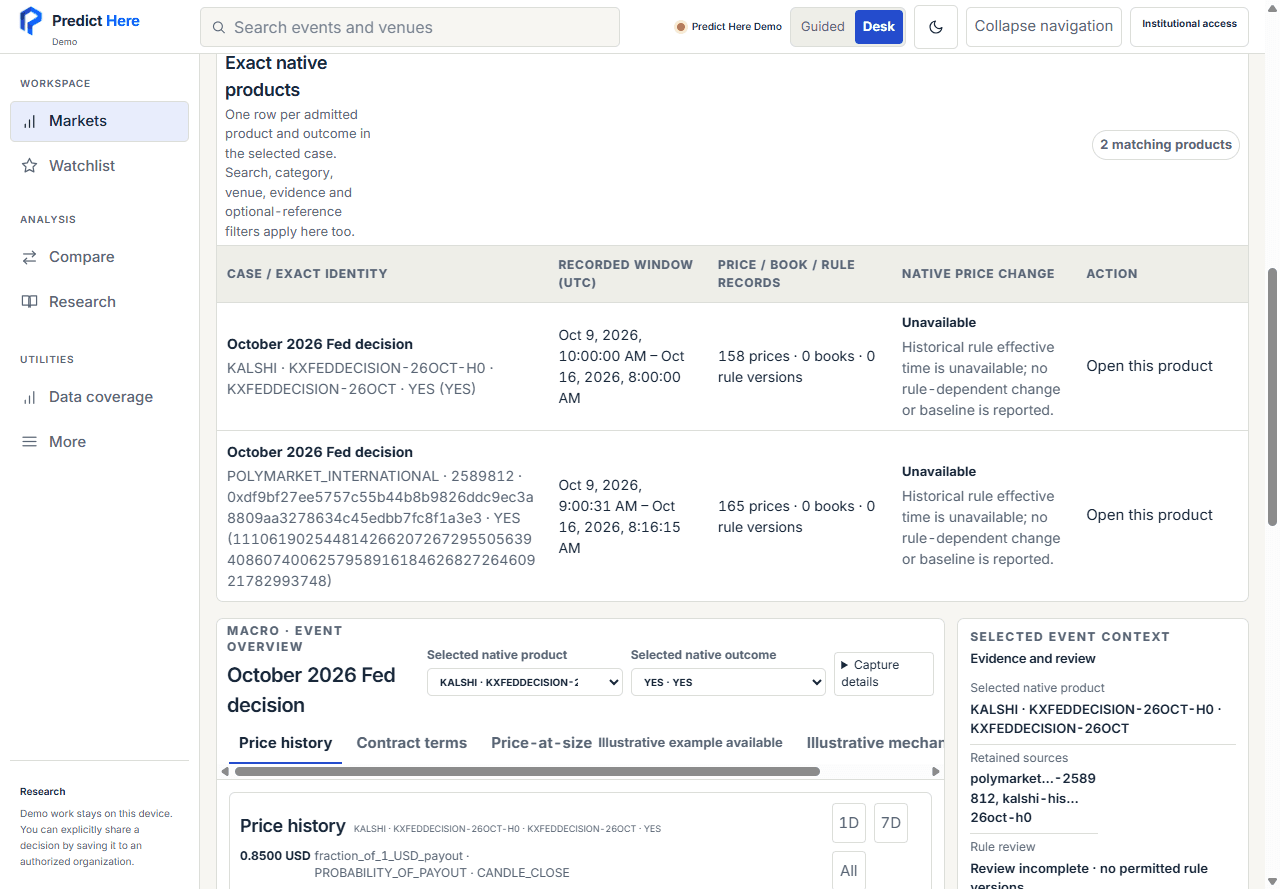
Markets · My universe
Demo capture · 17 October 2026 · recorded archive cutoff 16 October 2026 · no live quotes
Questions people ask before they sign up
Short answers, each one traceable to the same configuration the product runs on.
Can I try Predict Here for free?
Yes. Explore is free and permanent, with a verified email and no credit card. An evaluation that ends returns your organization to the Explore plan. Real event data remains subject to current source rights; neither signup nor a plan grants those rights.
Does Explore require a credit card?
No. There is no card, no payment details and no invoice on Explore. The paid states are negotiated with us directly, and nothing on this site charges you.
What data will I actually see?
15 curated events, classified under taxo_v1, with contract semantics and provenance on every record — a source, an as-of timestamp and the version identifiers of the math behind each figure. Price-at-size is computed from visible depth at the standard ladder, which runs 6 points from $10,000 to $1,000,000; Explore gets real numbers at $10,000 and sees the other 5 sizes locked, and the full ladder opens on an evaluation or an Institutional plan. Real event data requires current organization source rights and enabled sources; signup and a plan do not grant those rights.
What are the Explore limits, exactly?
15 curated events. One watchlist holding up to 10 events. One seat — Explore is one analyst looking at the product, not a desk. No alert rules: standing alert work re-evaluates on every collector tick and sends real email, so it is not something a free tier carries. And price-at-size at $10,000, with the other 5 ladder sizes visible but locked. A second seat and the full ladder are the first things an evaluation opens. Real event data requires current organization source rights and enabled sources; signup and a plan do not grant those rights.
Is the data live?
No feed on this site is labeled real-time. Coverage and update cadence vary by source and by feature — canonical Monitor data is delayed, not streamed. Its collector ticks every minute, and a collected quote older than 10 minutes is read as stale rather than presented as fresh. Eligible licensed Polymarket US records can also enter shared scheduled collection; its dedicated workspace additionally supports on-demand reads. See the methodology for how each Monitor state is defined.
Can I use the API?
The Developer Sandbox, yes — self-serve from your account settings at any tier. It returns synthetic example data using the documented response shape; nothing it returns reflects any real market. Canonical Monitor, retained source-catalog and event-consensus routes use authenticated organization sessions. Production API-key transport for those routes is not implemented, and a plan does not grant third-party source rights. See the docs for the data model.
Can I explore historical prices?
Yes. The public historical demo presents permission-cleared archived price series for six products across three cases (798 prices). It has no live quotes, retained orderbooks or rule versions. CSV and SVG downloads are limited to the currently permitted demo view. Institutional bulk historical exports for backtesting remain planned and are not available at any tier.
Does Predict Here execute trades? Does it hold funds?
No to both. Predict Here Institutional is a read-only data and intelligence product. It does not list markets, custody client funds, take the other side of a trade, or execute orders. It also does not provide investment advice.
Which venues are available?
The shared Monitor pipeline supports eligible Polymarket US records alongside other enabled sources. US capture requires source authorization, separate organization rights and a reviewed fixed-payout approval; the dedicated workspace also supports on-demand catalog and book reads. Neither plan tier nor international Polymarket rights grants US access. Production activation remains separately gated.
What is implemented for cross-venue comparison?
Cross-venue comparison and PH Composite are implemented as conditional, organization-scoped workflows. Each result needs at least two distinct entitled sources, a current human-reviewed equivalent mapping and fresh valid observations in the shared Monitor pipeline. US prices also require a current fixed-payout admission. US and Kalshi production collection are enabled under recorded owner-attested permissions; the dedicated US workspace does not bypass those gates.
Can my firm use its own licensed source entitlement?
Yes, in principle. Where your firm already holds a license from a venue, we can operate against that entitlement rather than ours, with redistribution limits recorded on your organization and enforced server-side on every request. It is a scoping discussion for an evaluation or an Institutional plan, not a self-serve switch, because it turns on the terms of your license rather than on a setting.
What does an evaluation actually commit us to?
A conversation and a window. You tell us the event universe and the workflow; we qualify the request and approve it, and activation is a separate step you control, so the 14-day window does not start until your team is ready. There is no automatic conversion at the end — access returns to Explore unless we have agreed terms.
On pricing
We do not publish a price list, and nothing on this site quotes one. Explore is free. Evaluation and Institutional terms are set per organization against the event universe, the delivery mode and the source entitlements involved, and we would rather tell you a real number on a call than an invented one on a page.
PREDICT HERE · DEMO
Follow a market idea through a decision.
Select an exact contract, assess an illustrative proposal, review the assumptions and export a reproducible decision.
The Markets view presents permission-projected historical observations where available. The guided position and mechanics examples use explicitly labeled assumptions or fictional inputs. Missing terms, books, rights or source coverage stay unknown. Nothing shown is a live quote, executable order, custody service or settlement claim; this tour does not establish a completed hosted team workflow.
Still deciding?
Open Explore now and look at the real product, or tell us about your event set and workflow and we will answer directly.